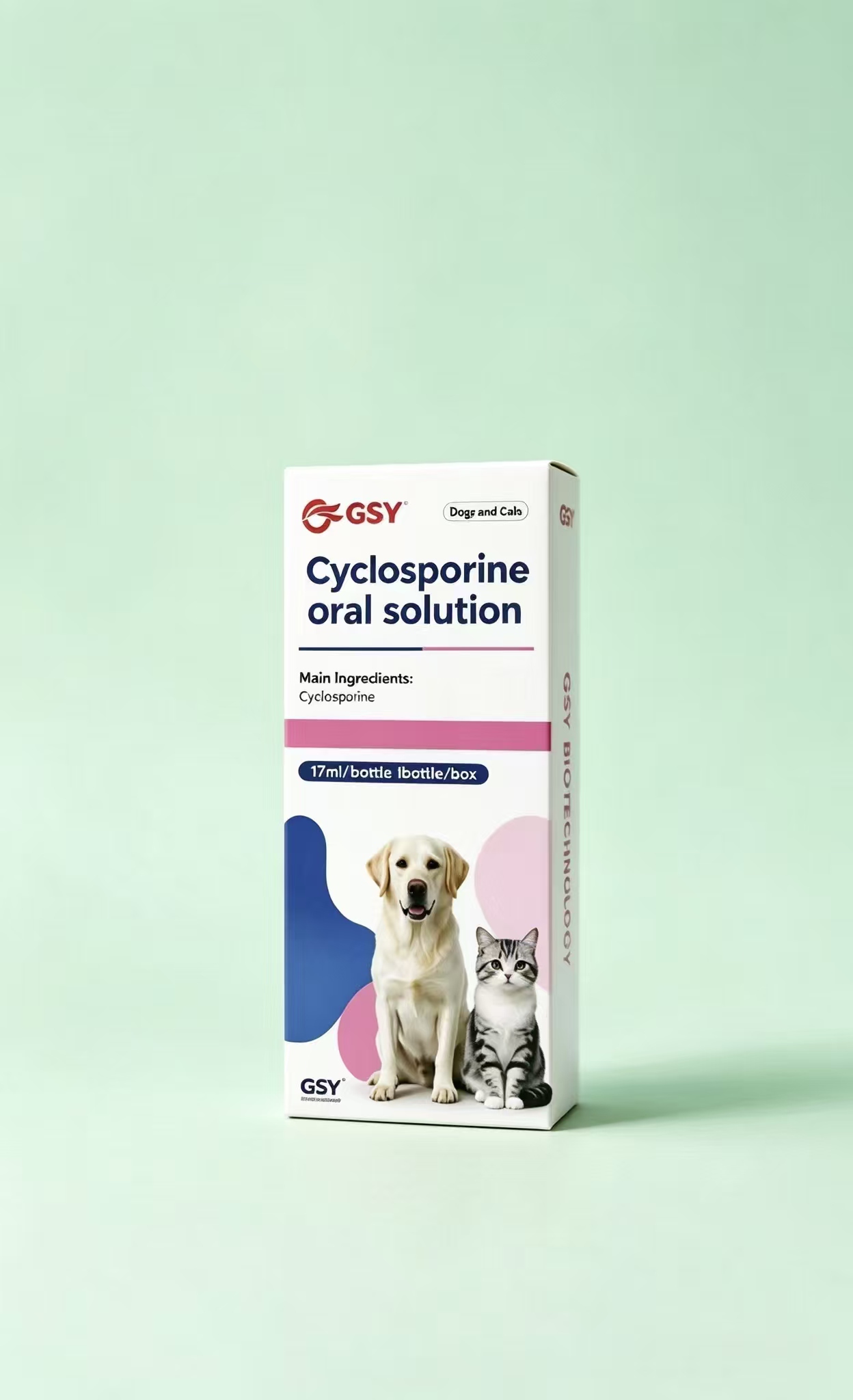
Product Information
Main Ingredients: Cyclosporine
Description: This product is a light yellow or yellow clear oily liquid.
Indications: Used for the treatment of chronic atopic dermatitis in dogs and chronic allergic dermatitis in cats.
Usage and Dosage:
Calculated by cyclosporine. Oral administration: For every 1kg of body weight, dogs 5mg (equivalent to 0.05ml of this product); cats 7mg (equivalent to 0.07ml of this product).
Dogs should be administered the drug at least 2 hours before or 2 hours after feeding. During administration, insert the dosing device directly into the dog's oral cavity and inject the full dose. Cats can be administered by mixing with food or by direct oral administration. If administering with food, this product should be mixed with a small amount of food. To ensure the cat completely consumes the medicated food, it is best to fast the cat sufficiently before administration. When administering directly using the dosing device, insert the dosing device into the cat's oral cavity and inject the full dose.
During the initial treatment period, this product should be administered daily until satisfactory improvement in clinical symptoms is observed (usually within 4 weeks for dogs, and 4 to 8 weeks for cats). If there is no improvement in dogs within 8 weeks, treatment should be discontinued. The affected dog or cat and the treatment plan should be regularly re-evaluated.
Once the clinical signs of atopic dermatitis or allergic dermatitis are satisfactorily controlled, this product can be administered once every other day. In some cases where clinical symptoms can be controlled by administering once every other day, the veterinarian may administer this product once every 3 to 4 days. Treatment can be stopped when clinical symptoms are controlled. When clinical symptoms recur, treatment should be resumed with daily administration. In some cases, repeated treatment may be necessary.
Adverse Reactions:
Dogs
The most common adverse reactions are gastrointestinal disorders, such as hypersalivation, vomiting, mucoid or soft stools, and diarrhea. These symptoms are mild and transient, and usually do not require discontinuation of treatment.
Other less common adverse reactions include somnolence or hyperactivity, anorexia, mild to moderate gingival hyperplasia (excessive gum growth), skin reactions (such as wart-like lesions or coat changes), erythema of the pinnae (outer ears), muscle weakness, or muscle spasms. These symptoms usually resolve on their own after discontinuation of treatment.
Very rare adverse reactions include diabetes mellitus, primarily reported in West Highland White Terriers.
Cats
Decreased appetite and weight loss may occur during treatment with this product. Weight monitoring is recommended. Significant weight loss may lead to hepatic lipid accumulation. If persistent, progressive weight loss occurs during treatment, it is recommended to discontinue treatment until the cause is determined.
Gastrointestinal disorders, such as vomiting and diarrhea, are very common. These symptoms are usually mild and transient, and do not require discontinuation of treatment.
Precautions:
This product shall not be used in cats infected with feline leukemia virus (FeLV) or feline immunodeficiency virus (FIV).
This product shall not be used in dogs and cats with a history of malignant diseases or progressive malignant diseases.
The efficacy and safety of cyclosporine have not been evaluated in cats under 6 months of age or weighing less than 2.3kg. It shall not be used in cats under 6 months of age or weighing less than 2.3kg.
It shall not be used in dogs under 6 months of age or weighing less than 2kg.
The safety of the drug has not been studied in breeding male cats and dogs, or pregnant or lactating female cats and dogs. A comprehensive risk/benefit analysis should be conducted before use in breeding, pregnant, or lactating cats or dogs.
Cyclosporine may cause elevated blood glucose levels. The effect of cyclosporine on diabetic dogs and cats has not been evaluated. It is not recommended to use cyclosporine in diabetic dogs and cats.
Although cyclosporine does not induce tumors, it can inhibit T lymphocytes, so treatment with cyclosporine may increase the incidence of clinically apparent malignant tumors. If lymph node lesions are observed in dogs and cats receiving cyclosporine treatment, it is recommended to conduct further clinical studies and discontinue treatment if necessary.
Many drugs can competitively inhibit or induce the enzymes involved in the metabolism of cyclosporine, especially cytochrome P450 (CYP 3A4). Azole compounds (such as ketoconazole) can increase the blood concentration of cyclosporine in dogs and cats. Macrolide drugs (such as erythromycin) can double the plasma cyclosporine level. Certain inducers of cytochrome P450, anticonvulsants, and antibiotics (such as methoxybenzamide, sulfadiazine) can reduce the blood concentration of cyclosporine.
As a substrate and inhibitor of the MDR1 P-glycoprotein transporter, co-administration of cyclosporine with P-glycoprotein substrates (such as macrolides) can reduce the efflux of these drugs from blood-brain barrier cells, potentially leading to central nervous system (CNS) toxic signs. In clinical studies on cats treated with cyclosporine in combination with selamectin or milbemycin oxime, no correlation was found between the combined use of these drugs and neurotoxicity.
Cyclosporine may increase the nephrotoxicity of aminoglycoside antibiotics and methoxybenzamide. It is not recommended to use cyclosporine simultaneously with these active ingredients.
Treatment with this product may cause a reduced immune response to vaccination. It is not recommended to vaccinate during treatment or within two weeks before or after drug administration.
For cats that are seronegative for Toxoplasma gondii, there is a risk of developing toxoplasmosis if infected during treatment. In very rare cases, it may be fatal. Therefore, the possibility of seronegative cats coming into contact with Toxoplasma gondii should be minimized (e.g., indoor rearing, avoiding raw meat or poultry). In a controlled experimental study, cyclosporine was found not to cause an increase in the shedding of Toxoplasma gondii oocysts. If toxoplasmosis or other severe systemic diseases are discovered during treatment, the use of cyclosporine should be discontinued and appropriate treatment should be initiated.
Due to the immunosuppressive effect of cyclosporine, any other infections should be appropriately treated before starting treatment. Infections occurring during treatment do not require discontinuation of the drug unless the infection is severe.
It is not recommended to use simultaneously with other immunosuppressants.
Accidental ingestion of this product may cause nausea and/or vomiting; seek medical attention immediately. Avoid contact with eyes. If contact occurs, rinse thoroughly with plenty of water.
Cyclosporine may cause hypersensitivity (allergic) reactions. People allergic to cyclosporine should avoid contact with this product.
Keep out of reach of children.
Withdrawal Period: Not required.
Specification: 10%
Storage: Protect from light, store tightly sealed below 25℃, avoid refrigeration.
Validity Period: 36 months. Use up within 11 weeks after opening.