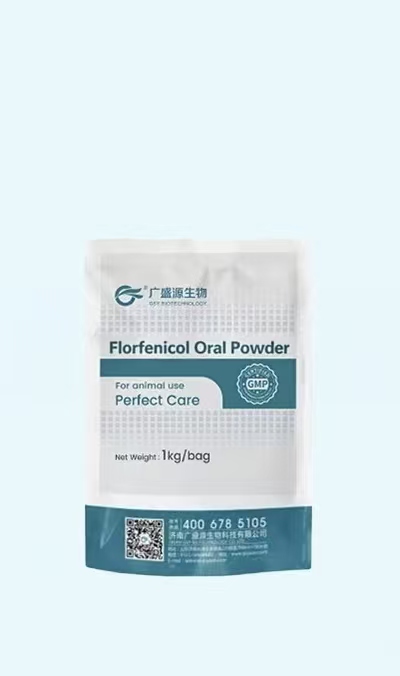
Product Information
Main Ingredients: Florfenicol
Description: This product is a white or off-white powder.
Pharmacological Action:
Pharmacodynamics: Florfenicol belongs to the amide alcohol class of broad-spectrum antibiotics and acts as a bacteriostatic agent. It exerts its effect by binding to the 50S ribosomal subunit to inhibit bacterial protein synthesis. It possesses strong antibacterial activity against various Gram-positive and Gram-negative bacteria. Pasteurella haemolytica, Pasteurella multocida, and Actinobacillus pleuropneumoniae are highly sensitive to florfenicol. In vitro, the antibacterial activity of florfenicol against many microorganisms is similar to or stronger than thiamphenicol. Some bacteria that have developed resistance to amide alcohols due to acetylation, such as Escherichia coli and Klebsiella pneumoniae, may still be sensitive to florfenicol.
It is mainly used for bacterial diseases in pigs, chickens, and fish caused by sensitive bacteria, such as respiratory system diseases in cattle and pigs caused by Pasteurella haemolytica, Pasteurella multocida, and Actinobacillus pleuropneumoniae. It treats typhoid and paratyphoid caused by Salmonella, fowl cholera, fowl typhoid, colibacillosis, etc.; and bacterial septicemia, enteritis, and erythroderma in fish caused by Pasteurella, Vibrio, Staphylococcus aureus, Aeromonas, Enteritis bacteria, etc.
Pharmacokinetics: Florfenicol is rapidly absorbed orally, reaching therapeutic concentrations in the blood about 1 hour after administration, and reaching peak blood concentration in 1 to 3 hours. Bioavailability exceeds 80%. Florfenicol is widely distributed in the animal body and can penetrate the blood-brain barrier. It is mainly excreted unchanged in urine, with a small amount excreted in feces.
Drug Interactions: (1) Macrolides and lincosamides have the same site of action as this product, both binding to the bacterial ribosome 50S subunit. Concurrent use can produce mutual antagonism.
(2) It may antagonize the bactericidal activity of penicillins or aminoglycosides, but this has not yet been proven in animals.
Function and Indication: Amide alcohol antibiotic. Used for the treatment of bacterial diseases caused by sensitive bacteria in chickens.
Dosage and Administration: Calculated based on this product. Drinking water: For every 1L of water, 2~4g for chickens, used consecutively for 3~5 days.
Adverse Reactions: This product has a strong immunosuppressive effect when used at doses higher than recommended.
Precautions: (1) Chickens laying eggs for human consumption must not use this product during the laying period.
(2) Use with caution in breeding chickens.
(3) Contraindicated in animals during vaccination or with severely compromised immune function.
Withdrawal Period: Chickens: 5 days.
Specification: 5%