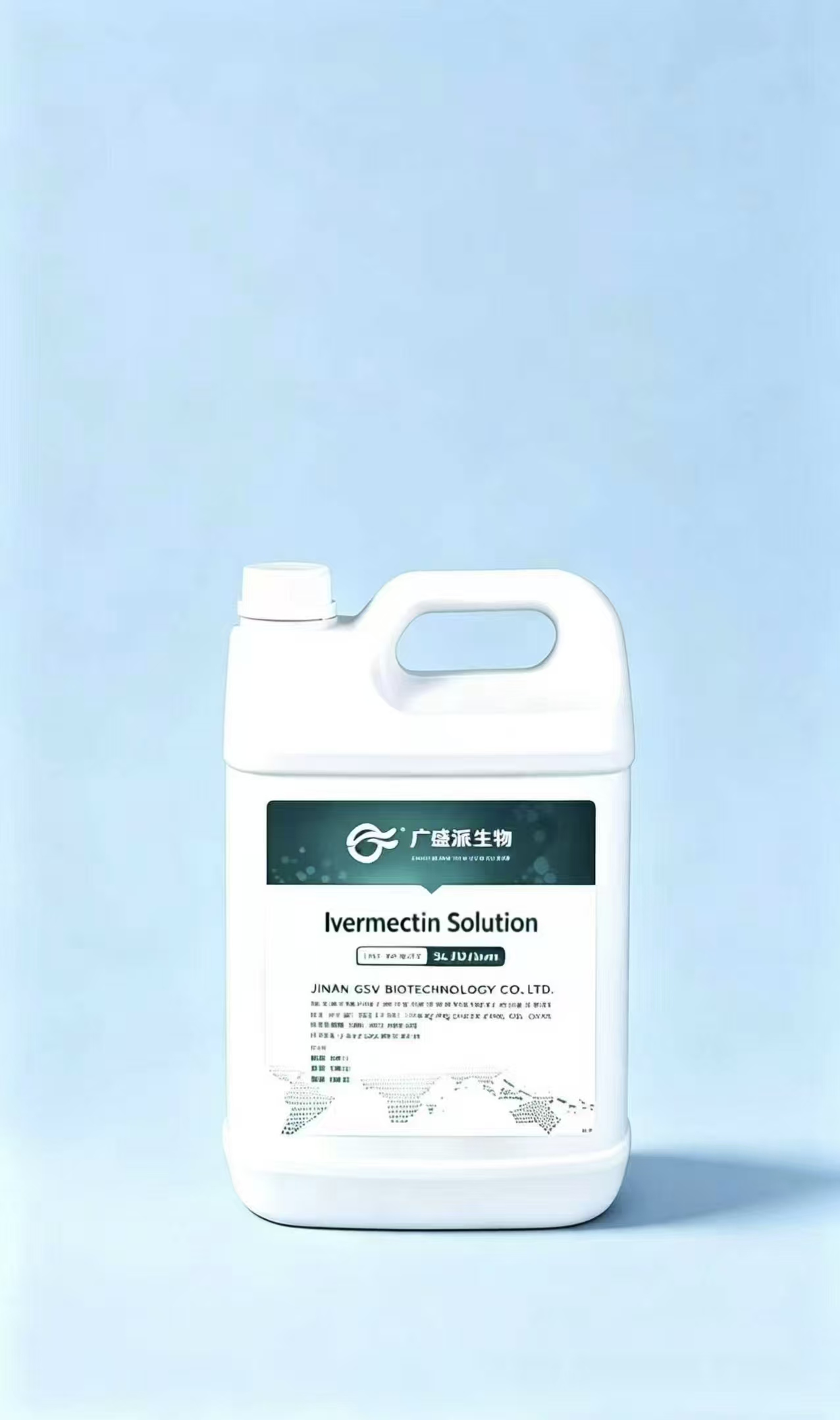
Product Information
Main Ingredient: Ivermectin
Description: This product is a colourless clear liquid.
Pharmacological Actions:
Pharmacodynamics: Ivermectin exhibits good insecticidal effects against internal nematodes and ectoparasitic arthropods. Its anthelmintic mechanism is to promote the presynaptic neurons to release γ-aminobutyric acid (GABA), thus opening the GABA-gated chloride channels.
Ivermectin also has selectivity and high affinity for glutamate-gated chloride channels near GABA-mediated sites in nerve and muscle cells of invertebrates. It interferes with neuromuscular signal transmission, paralyzing parasites in a flaccid state and leading to parasite death or expulsion out of the host. The inhibitory interneurons and excitatory motor neurons of nematodes serve as its action sites, while the neuromuscular junctions are the action sites for arthropods.
For sheep, the elimination rate of adult worms and L4 larvae of Haemonchus contortus, Ostertagia, Cooperia, Trichostrongylus (including Trichostrongylus axei), Oesophagostomum, Bunostomum, Nematodirus, Trichuris, Oesophagostomum, Dictyocaulus filaria and Chabertia ovina reaches 97%~100%. It is highly effective against arthropods such as maggots, mites and lice, with slightly poorer efficacy against biting lice and sheep keds.
Ivermectin is also highly effective against ticks and flies breeding in faeces. Although it cannot kill ticks immediately, it impairs feeding, moulting and oviposition, thereby reducing reproductive capacity. It exerts similar effects on horn flies.
For pigs, the elimination rate of adult and immature worms of Ascaris suum, Oesophagostomum rubidus, Strongyloides ransomi, Trichuris suis, Oesophagostomum, Metastrongylus, Stephanurus dentatus reaches 94%~100%. It is highly effective against intestinal trichinella (ineffective against intramuscular trichinella), and can well control pig lice and pig scab mites. It has no effect on trematodes and cestodes.
Pharmacokinetics: The pharmacokinetics of ivermectin vary significantly with animal species, dosage forms and administration routes. Subcutaneous administration yields higher bioavailability than oral administration, while oral administration achieves faster absorption than subcutaneous injection. After absorption, it distributes well to most tissues but hardly penetrates cerebrospinal fluid. The apparent volume of distribution in sheep and pigs is 4.6 L/kg and 4 L/kg respectively. It has a relatively long half-life in most animals: 2~7 days for sheep and 0.5 days for pigs. This product is metabolized in the liver; hydroxylation is the main metabolic pathway in sheep, whereas methylation predominates in pigs. It is mainly excreted via faeces, with less than 5% excreted in urine in the form of parent drug or metabolites. Up to 5% of the administered dose can be excreted into milk in lactating dams.
Drug Interactions: Concurrent use with diethylcarbamazine may cause severe or fatal encephalopathy.
Actions and Indications: A macrolide antiparasitic drug. For prevention and treatment of nematodiasis, acariasis and parasitic insect diseases in sheep and pigs.
Dosage and Administration: Oral administration. Single dose: 0.1 mL per kg body weight for sheep; 0.15 mL per kg body weight for pigs.
Adverse Reactions: No adverse reactions have been observed when used in accordance with the specified dosage and administration.
Precautions:
(1) Sheep producing milk for human consumption must not be used during lactation.
(2) Use with caution in sows during the first 45 days of gestation.
(3) Ivermectin is highly toxic to shrimp, fish and aquatic organisms. Packaging and containers with residual drug must not contaminate water sources.
Withdrawal Period: 35 days for sheep; 28 days for pigs.
Specification: 0.1%, 0.2%,0.3%
Storage: Store in a tightly sealed container in a cool, dark and dry place.